Wednesday, August 26, 2009

And so the day has arrived

My first post in this blog last February anticipated this day, and so it has arrived - as it always does, and as it will for all of us.

I don't really have much more to say about Ted Kennedy. There are plenty of detailed accolades already in print and online, and so many more to come.

He was my Senator for the entire 32 years I've lived in Massachusetts. I was happy to vote for him, proud. If he had come to our hospital when he first became ill with the brain cancer that ultimately killed him, my colleagues and I would have provided him with the best care possible, because that's what we do for every one of our patients.

The fact that he has died proves he is, in the most essential ways, no different than the rest of us. Sure, his father was one of the richest men in the country of his time, and that fact brought opportunities and advantages to Ted that most of us can only imagine, or envy.

But my work, our work, with the dying and their families brings us closer to people than most others will ever experience. That, too, provides opportunities and advantages, most notably the chance to see that we're pretty much all the same.

photo cropped from one taken last year by Stephan Savoia for Associated Press, obtained at this site, and captioned "Sen. Edward M. Kennedy, D-Mass., smiles as he sit with his daughter, Kara Kennedy, in a family room at the Massachusetts General Hospital in Boston."

Update: AdamB, writing at DailyKos, links to Ted Kennedy's speech at the 1980 Democratic National Convention, when he conceded the nomination to Jimmy Carter. This passage stands out among many noble phrases:
"...we cannot have a fair prosperity in isolation from a fair society. So I will continue to stand for a national health insurance. We must -- We must not surrender -- We must not surrender to the relentless medical inflation that can bankrupt almost anyone and that may soon break the budgets of government at every level. Let us insist on real controls over what doctors and hospitals can charge, and let us resolve that the state of a family's health shall never depend on the size of a family's wealth."

Update #2: NCrissieB, also writing at DailyKos, has a passionate essay:
"Most of the time, funerals aren't really about the dead but about the living. The dead need mourning rituals the way fish need bicycles. It's the living who need those mourning rituals, to communalize the grief and crystallize what is now absent by celebrating what was once present. Most of the time, the eulogy is about our memories of the deceased, what he/she meant to us.
Read the whole thing.

Update #3: Here's the C-Span feed of the closing song from Kennedy's Friday night 'Celebration of Life.' Indeed, "it's the living who need these mourning rituals."

Watch the whole thing. I'm glad somebody uploaded the C-Span feed, and not the feed from NECN or some other outlet where the newsreaders feel obligated to endlessly chatter their nonsense.


Update #4: Joan McCarter, writing at DailyKos, says:
"He recognized that by a twist of fate by being born a Kennedy, he was born into a life of wealth, power, and privilege. But unlike so many of the wealthy, the powerful, he lived daily with the conviction of the inequity of life in America."

Tuesday, August 25, 2009

Three to get ready...

Now go, cat. Go!

So, I guess I can say that it's semi-official - my proposal to develop and end of life care team specifically for our unit has been approved to actually happen. I'm psyched.

We're looking at a series of three class meetings held one month apart, beginning in October. Each will last four hours, and the entire course will touch on the full set of nine ELNEC modules.

I was also asked to build the first class around modules that would be useful for non-nurses, because at least one physician, our unit's assigned chaplain, and one or both of our assigned social workers want to attend that session. At this point, I'm planning to build content around the topics of ethics, communication, and grief/bereavement.

There are also three other ELNEC trainers at my hospital, and two of them are heading up a 3-part course in October/November that is available to nurses on all of the units. They've asked me to help with one of the modules, and of course I'm very happy to do so.

It's been clear to me for as long as I can remember that end of life care needs to be a huge overall priority, not just at my hospital but throughout the health care system. The dying and their families are very badly served in the acute care setting that many of us practice in.

That's certainly not for lack of caring. I think most of us do our best on a case by case basis. It's just that hospitals, medical centers, and clinicians are geared to other things.

But the wheel's turning, even if it's turning more slowly than I'd like.

Friday, August 21, 2009

Have these lying idiots created an opening?

I made a conscious decision to avoid overt political discussions when I started this blog.

I also felt it was important to not comment on the ridiculous assertion that proposals to reform our very dysfunctional health care system include ominous provisions that would "pull the plug on grandma."

I don't have the patience to listen to folks who demagogue the issue, or to counter, point by point, their gross distortions.

Thankfully, comedian/TV host Jon Stewart does:

Part 1


Part 2


Liars.

Idiots.

Lying idiots.

However, in my search for the silver lining, here's a question - "Have these lying idiots created an opening? Is this our chance to have more and better honest discussions with people about end of life care?"

It's a rhetorical question. We can always have more of these conversations, and better ones, with our family, friends, and patients.

But maybe now it just got a little bit easier.

And maybe now I can go back to following my earlier inclinations to avoid overt political discussions.

8/24 Update: And the lying idiocy continues.

9/2 Update: The Hospice and Palliative Nurses Association tackles this issue head-on in their latest newsletter:
Opponents of health reform efforts are misrepresenting parts of the House and Senate legislation. In particular, the Affordable Health Choices Act contains a provision (page 425 of H.R. 3200) that would provide coverage under Medicare for people to talk to their doctor about their wishes. This provision has been used as a scare tactic by those who are claiming that it is a step toward government-mandated euthanasia for the elderly.

In fact, it is nothing of the sort.

More here.

Tuesday, August 4, 2009

Another poem

I've been busy, certainly. My work is daily contact with sickness, pain, death, and grief. It's work that I've chosen to do, that I've sought out and been educated for, that I actively engage with.

I haven't shared any specifics yet, either from my current practice or from past encounters. I very much want to, and I'm going to find ways to do so that are consistent with ethics and the law.

I just don't know what those best ways are right now.

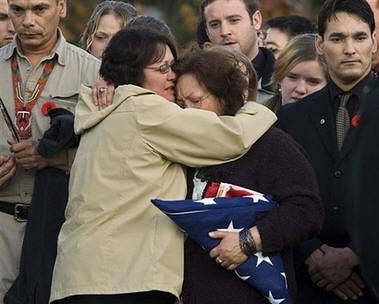
In the meantime, here's another image and poem:

Theresa Seeley is comforted by a friend as she clutches the American flag presented to her at the burial of her son, U.S. Army Sgt. Michael Seeley, in St. Anthony's Cemetery in Fredericton, New Brunswick, Canada, Thursday, Nov. 9, 2006. Seeley, a member of the Mi'Kmaq First Nation, was killed in a bomb attack on Oct. 30 while on duty with the U.S. Army in Iraq.
(AP Photo/Andrew Vaughan, CP)

Evening
by Gail Mazur

Sometimes she's Confucian--
resolute in privation. . . .

Each day, more immobile,
hip not mending, legs swollen;

still she carries her grief
with a hard steadiness.

Twelve years uncompanioned,
there's no point longing for

what can't return. This morning,
she tells me, she found a robin

hunched in the damp dirt
by the blossoming white azalea.

Still there at noon--
she went out in the yard

with her 4-pronged metal cane--
it appeared to be dying.

Tonight, when she looked again,
the bird had disappeared and

in its place, under the bush,
was a tiny egg--

"Beautiful robin's-egg blue"--
she carried carefully indoors.

"Are you keeping it warm?"
I ask--what am I thinking?--

And she: "Gail, I don't want
a bird, I want a blue egg."
- - - - -

Tuesday, July 21, 2009

Returning to the poetry of grief

I began a regular series of "diaries" several years ago as a registered member of the DailyKos community, based on linking wire services photos, mostly from the invasion and occupation of Iraq, with poems that I was familiar with, or that I found online.

My idea was to use the words and images to acknowledge and express grief - both as a witness to the grief of others; and as a more direct personal statement about what was happening.

I developed over 600 entries in the DailyKos series, beginning just after the 2004 presidential election and lasting until mid-January, 2007, at which point I developed a blog that continued the series, though with less frequency, for another year.

I haven't done anything else with my project since that time, but thought it would be good to try picking up again here. I'll start by simply copying from that earlier work, at least once each week.

- - - - -
Cayetana G. Palacios cries as her son, U.S. Army Corporal Eric G. Palacios-Rivera, of Atlantic City, N.J., is posthumously recognized with the Drum Major for Community Service award, during the New Jersey Martin Luther King Jr. Commemorative Commission's annual King Holiday Celebration, Sunday, Jan. 14, 2007, at the War Memorial in Trenton, N.J. Palacios-Rivera was killed in action in Iraq on Nov. 14, 2006. He is pictured on his mother's shirt.
(AP Photo/David Gard)

from Mass for the Day of St. Thomas Didymus

by Denise Levertov

ii Gloria

Praise the wet snow

falling early.

Praise the shadow

my neighbor's chimney casts on the tile roof

even this gray October day that should, they say,

have been golden.

Praise

the invisible sun burning beyond

the white cold sky, giving us

light and the chimney's shadow.

Praise

god or the gods, the unknown,

that which imagined us, which stays

our hand,

our murderous hand,

and gives us

still,

in the shadow of death,

our daily life,

and the dream still

of goodwill, of peace on earth.

Praise

flow and change, night and

the pulse of day.

Saturday, July 11, 2009

Some helpful constructs

Two Paths Through Pines
photograph by Mark A. Kawell


I’ve developed several metaphors that have proven helpful when talking to families facing catastrophic injury/illness and the possibility of death, and who need to understand end of life care in a meaningful context.

To start, let's stop using the awful expression “withdrawing care.” None of us would feel comfortable taking something away from a loved one, especially when that something is literally keeping our loved one alive.

I use the term “redirecting care,” to emphasize our conscious decision to focus on a specific set of objectives – most notably comfort, dignity, and family closeness. This idea also makes better sense when considered in the context of what I describe to families as the three basic paths guiding care in the acute setting.

Curing – The first path focuses on curing the patient’s underlying illness or injury. I use antibiotic therapy and surgery as examples. Often, the patient’s own history includes one or more initial treatments directed at curing, so this is pretty straightforward for most people to understand.

When a patient’s condition is dire, it also helps the family see that the path to a cure may be highly uncertain at best, or even unrealistic, no matter how desperately they may hope otherwise.

Support for Healing – The second path emphasizes actions that support the patient’s own ability to heal. I point to interventions like the nutrition from high calorie/high protein tube feedings, and intubation with mechanical ventilation, as ways that we help a patient get better. I also point out that these measures are generally only needed for a limited time, even if that temporary period extends for weeks.

When a patient hasn’t improved or recovered despite our actions, the family usually finds it easier to understand that the possibility for healing has become more remote.

Comfort and Dignity – The third path is entirely devoted to keeping the patient comfortable in whatever way is required - controling pain, easing air hunger, and calming agitation; and to maintaining the patient’s identity as a person with friends and family who love them.

I also emphasize and identify ways that the family can join in providing this comfort and insuring this dignity.

Families are more at ease when they’re confident we’ll help keep their loved one comfortable, and when they know they’ll all be treated with respect and not left alone.

I’ve found that these three concepts of care support more meaningful discussions with families to determine the most appropriate goals of care. We’re less likely to get into misunderstandings and struggles, and more likely to focus on what we all agree is most important.

- - - - -

Mark Kawell lives in Minnetonka and Ely, Minnesota…He studied photography, film, art and architecture at Bemidji State College, the University of Minnesota and the Minneapolis College of Art and Design.

Kawell worked for many years as a product and architectural photographer and was an instructor of large format photography at Bemidji State College

(snip)

During the last decade Mark has devoted more time to his personal photography. He has photographed in England, Holland, Italy, Germany, California, Washington, North Carolina Canada and Minnesota. He works primarily with a 4x5” wood field camera.

Wednesday, July 8, 2009

Vacation soon, then activity

I'm finally putting some things to rest, as I prepare to start some new activities including, I so fervently hope, my plans for developing an end of life care team at work.

I had a couple more discussions with the nurse manager of our unit this past week, and it seems like I'm finally going to soon get the formal go-ahead for the project I first proposed in January, and for which I started preparing last October.

Maybe I've been preparing for this project since I first attended an end of life care program in...2003, maybe. That was a day-long event at Boston's Beth Israel Hospital, now known as Beth Israel Deaconess Medical Center. BI is home to one of the best medical writers around, as well as to a blogging CEO.

Then again, maybe I've been preparing for this project since 1976. That was the year I graduated from a hospital-run school of nursing, and that my father died.

I'll ramp up the frequency of my posting here, and plan to include accounts of the project as well as others related to, or provoked by, the topics of living, dying, death, and the things that precede and follow them.

I've been working on a piece, mostly in my head, about the sudden loss of a colleague last month. I hope to get it down in pixels, in a form that's worthy of the subject, while I'm recharging next week.

Meanwhile, I came across this site while scoping out something entirely unrelated to where I ended up. Ain't that always the way?
Today is the first day after we buried Pablo's physical body in the ground at Forest Lawn. He is now fully and completely at rest. Now we will begin our journey of looking for Pablo's spirit and energy in our lives, in each other, in the world. It's not hard. He cast a wide net, my little Scrapper.

I want to write about the past two days, and I will. But today it's too hard. I can't touch it yet. It's too hot.